Why did stocks fall when the economy looked fine? Here's what I am watching.
Jun 09, 2026 7:56 am
Dear ,
Last Friday's market drop is worth a quick explanation.
The US economy actually had a decent week. Employers added 172,000 new jobs in May, and unemployment stayed low at 4.3%. On the surface, that sounds like good news.
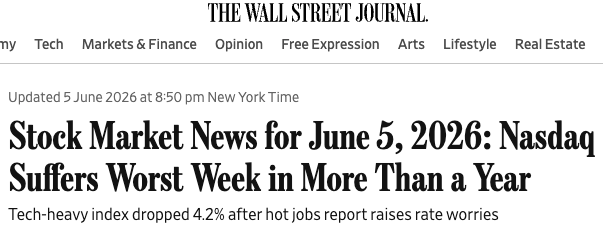
So why did stock prices fall?
The S&P 500 dropped 2.6%. Tech stocks fell even harder, with the Nasdaq down 4.2%.
Companies that make chips for computers and AI were hit especially badly.
Here's the simple reason: good news for jobs can be bad news for markets right now.
When lots of people are employed and spending money, it keeps prices high. And when prices stay high, the US central bank, the Federal Reserve has less reason to bring down interest rates.
High interest rates make it more expensive for companies to borrow and grow. That makes their future profits worth less today, which pushes their share prices down.
So in a strange way, a strong jobs report spooked investors rather than reassured them.
Markets are no longer moving in one direction
Right now, markets are being pulled in different directions all at once.
Steady economic growth on one hand, but also sticky inflation, high borrowing costs, political tensions around the world, and enormous excitement (and money) flowing into a small number of AI-related companies.
A good example of this is the recent SpaceX stock listing.
SpaceX listed on Nasdaq on 12 June at a value of roughly US$1.75 trillion, one of the biggest stock market launches ever.
A lot of investor money flowed into that one listing. When huge amounts of money rush into one place, it can pull money away from everywhere else even if you never planned to buy SpaceX shares yourself.
What gold is quietly signalling
Here's something that caught my eye.
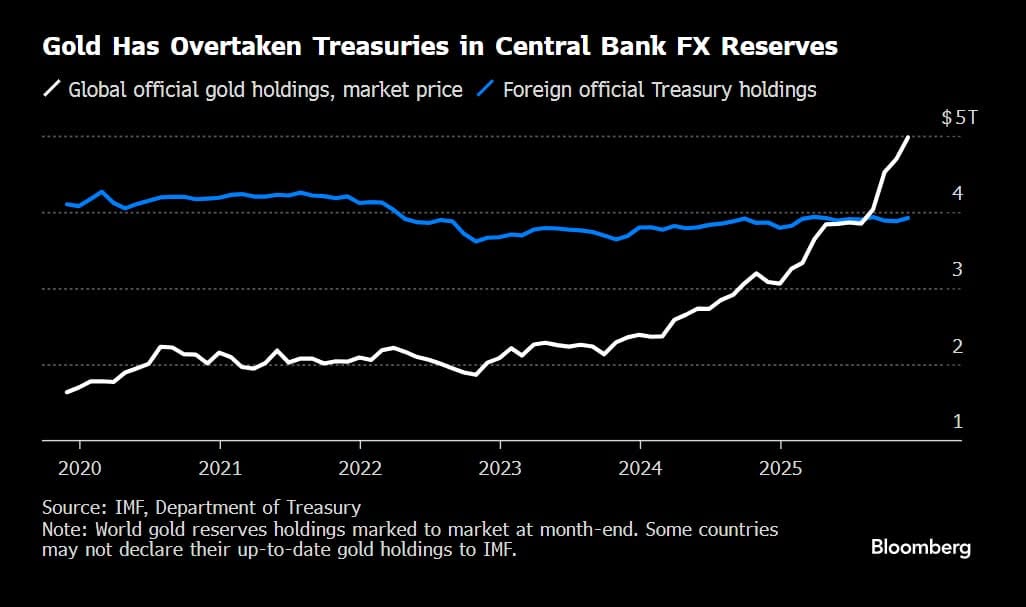
For the first time, gold has become the single largest asset held in reserve by the world's central banks, bigger even than US government bonds.
At the end of 2025, gold made up about 27% of global central bank reserves, compared to 22% for US bonds.
Central banks are essentially the savings managers for entire countries. When they start moving more of their reserves into gold, it tells us something.
It doesn't mean the world is falling apart.
But it does suggest that even the biggest financial institutions are quietly looking for safer, more stable stores of value in an uncertain world.
That's a signal individual investors probably shouldn't ignore either.
What this means for you
I'm not suggesting you sell anything or make sudden changes. Reacting emotionally to short-term market drops is one of the most reliable ways to damage long-term wealth.
The recent dip may turn out to be nothing more than a brief wobble.
But even brief wobbles are useful reminders to check that your financial foundation is solid, not just when markets are rising, but especially when they aren't.
In the meantime 'll keep a close eye on inflation figures, interest rate expectations and how markets respond to major events in the weeks ahead.
Regards,
Zest