My EuroCon experience, togetherness, and solidarity
Jul 09, 2026 8:25 pm

Adriana Kantcheva
Dispatches from a writer of what-ifs.
Hello, ,
I've just returned from this year's EuroCon (MetropolCon in Berlin) and am still buzzing. Why? The question is rather, why not? I met friends and made new ones. I chatted with Becky Chambers, Neil Clarke, and Aiki Mira, who were all incredibly friendly. I listened to riveting talks and panels.
And then there were all the languages and the sense of togetherness despite the borders, despite the language barriers, despite the differences. I felt part of a bigger whole rather than a disparate speck mingling with other disparate specks. It gave me hope that, despite all the forces pulling us apart, Europe will remain united and perhaps grow even more tightly knit. Perhaps one day, the world as well.
This was my first EuroCon but won't be the last.
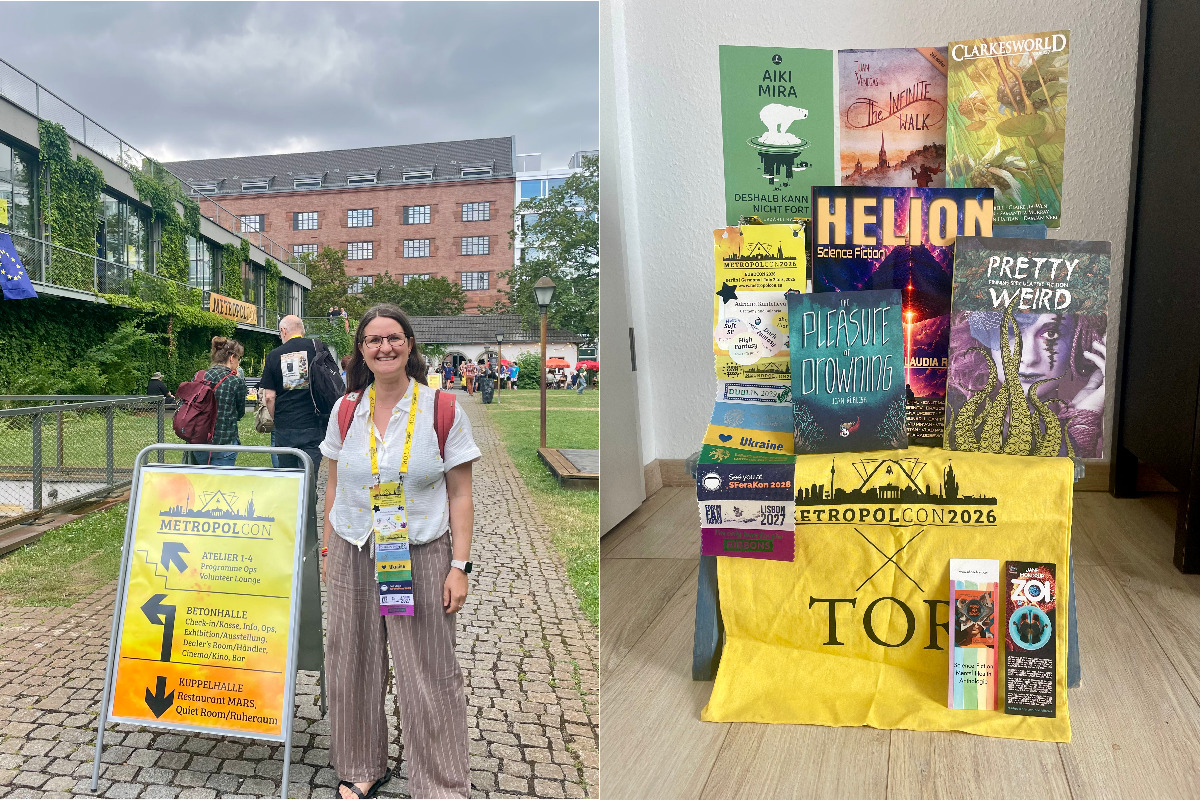
Image description: On the left, yours truly in a white shirt and brown pants standing next to a yellow MetropolCon poster outside the venue. On the left, my swag from the convention comprising three books (a short story collection by Aiki Mira, The Pleasure of Drowning by Jean Bürlesk, and The Infinite Walk by Juan Venegas) and three magazines (Clarkesworld printed edition, Helion magazine of Romanian SF, and Pretty Weird, a magazine of Finish speculative fiction).
EuroCon highlights for me
A panel about the state of European SF. There was a heated discussion about English's role in European speculative fiction. Does translation into English from the multitude of European languages flatten diversity? Are authors whose first language is not English but who write in English damage this diversity?
Some would answer "yes" to both questions. In my opinion, without English acting as the current lingua franca, there would have been no EuroCon. Even the heated discussion itself took place in English. I'm someone who's one of those authors, some might say a traitor to my mother tongue. Yet, the language I grew up with (and the other five languages I learned over the decades) inform every bit of my writing. All the cultures I came into contact with through learning their languages and all the people I've met tint my fiction in wholly unique ways. I view my writing in English as a bridge: it helps me communicate concepts and views deeply ingrained in my culture and worldview (as a Bulgarian, a German, a European) to people who might otherwise never come into contact with them.
I don't believe that a common language will do away with cultural richness, just as a common currency wouldn't either, and neither would removing borders. As long as there is geography, there will be regional differences. Such fears only fuel animosity.A talk by Emma King about how not to become an astronaut. Emma King was among the top 2% of over 20,000 applicants for the latest European Space Agency (ESA) call for astronaut candidates. This talk was wholly entertaining, but also very informative. My conclusion is that I have quite a few things going for me (have scuba dived, have been a flight attendant and so tried those weird psychological tests in aviation, am not overt to risk but not reckless, have a PhD in STEM), so I should definitely apply next time there's a call.
Live video call to the Polarstern icebreaker ship. Autun Purser is a senior researcher on the German icebreaker Polarstern (and a talented illustrator as well), and he generously spent an entire hour carrying his laptop from deck to deck to show us the ship and the type of research they do there. Needless to say, it's all super cool--from high resolution imaging of the seabed to sampling water in the wake of other ships. I left the talk close to tears. I wanted to be a marine biologist before ending up studying molecular biology and had a major case of witnessing my life in an alternate universe.
Guest of honor Aiki Mira's keynote speech. The whole hall was erupting in applause every five minutes. Aiki Mira is a German queer writer who has some thought-provoking things to say about AI and techno-fascism. My takeaway was not so much a blanket view of LLMs as utterly terrible, but rather the wrongness lies in the way they have been used by corporations and irresponsible individuals to push forward selfish agendas. There is something to be said about decoupling this technology from profit-first models of its use.
Talk by Valentin Ivanov about the European Southern Observatory (ESO) in Chile. Valentin Ivanov, a Bulgarian SF writer and an active astronomer working for ESO, presented ESO's observatory in Chile. My main takeaways (apart from all the cool, geeky technical facts) were that 1. Science is much cheaper than war (So why don't we do more science and no war?) 2. The observatory is a technological marvel showing the good side of humanity. 3. Astronomy is wonderfully collaborative because objects of interest are sometimes visible only from hemisphere, which is a great example for other, more competitive sciences. 4. Here's a demonstration of AI use for the benefit of humanity: with improving technology, astronomers are able to collect rich but also enormous datasets. No human mind can parse these. Without the use of AI, astronomy wouldn't make the leaps it can now.
Aiki Mira and Jol Rosenberg's discussion about queer utopias. The term radical solidarity will stay with me. I understand it as the type of solidarity that is given even at a personal cost, even without fully understanding or agreeing with the other side. It's a pathway to a world that is poly-lingual, poly-national, poly-ideological, poly-species and still at peace and thriving.
What I’ve been up to
EuroCon!
Continuing prose-level polishing of my fantasy novel (about one third through now).
Revising a short story.
Until next time!
Adriana
If you enjoy my newsletter, please share it with others.
If you’ve been forwarded this newsletter and like it, subscribe here.
adrianakantcheva.com | © 2026 Adriana Kantcheva